
 ChatGPT
 Claude
 Perplexity
 Grok
 Gemini
A robotic palletizing machine automatically stacks the cases coming off a production line onto a pallet according to a pre-calculated pattern. The machine designed and built by TAMTAŞ and presented at UMTİK 2026 brings together pallet layout optimization software, a 4-axis gantry robot arm and a vacuum gripper that can hold several cases at once. In field tests it stacked an average of 440 cases per hour and delivered a 400% increase in energy efficiency.
Key takeaways:
- An average of 440 cases per hour; manual stacking jobs that used to take a full day are finished in minutes.
- The layout software proposes four pallet patterns for each product, and the operator makes the final choice.
- Switching between product and pallet configurations takes only five seconds.
- An asymmetric layer pattern interlocks the layers, producing a load that stays stable in transit.
- Path optimization and multi-case picking raise energy efficiency by 400%.
Why does palletizing become the end-of-line bottleneck?
As filling and packaging speeds rise, the palletizing station at the end of the line often becomes its slowest link. When palletizing cannot keep pace, products pile up, the line stops and overall factory throughput drops. The labor shortages of the pandemic years also showed how exposed labor-dependent plants are to such external shocks.
Manual stacking carries two lasting risks: ergonomic health problems caused by heavy, repetitive lifting, and time losses caused by human error. On high-volume lines, moving to a fast and error-free robotic palletizing system is therefore no longer an option but a necessity.
How does a robotic palletizing machine work?
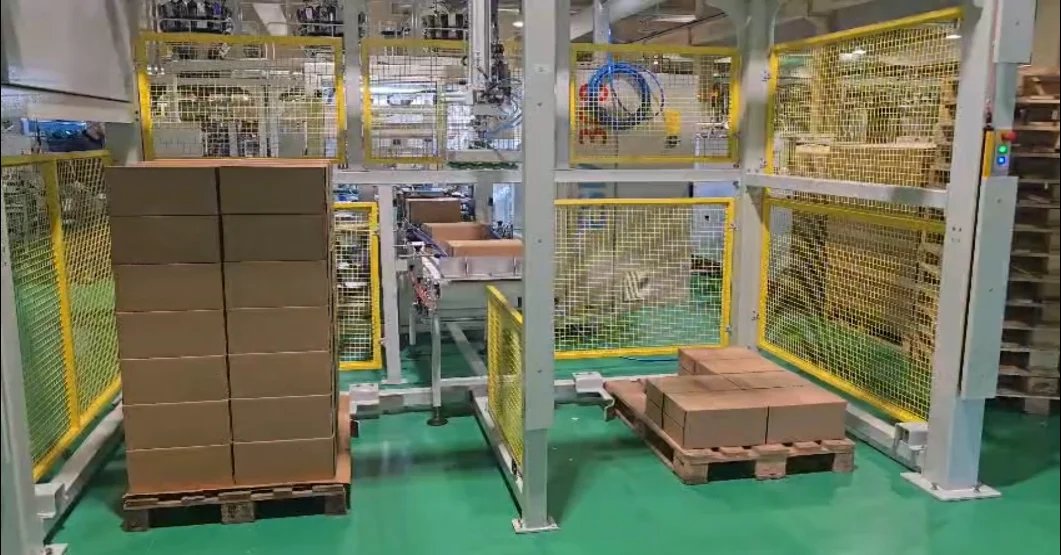
The machine is built on a rigid steel gantry frame that carries the robot arm. Before stacking starts, the control computer runs a layout algorithm that calculates the maximum number of cases that fit within the limits entered by the operator. Once the line is running, the robot arm moves linearly along the X, Y and Z axes and rotates around its own vertical axis (the A axis). The vacuum gripper picks one or more cases at a time from the infeed conveyor and places each one at its calculated position.
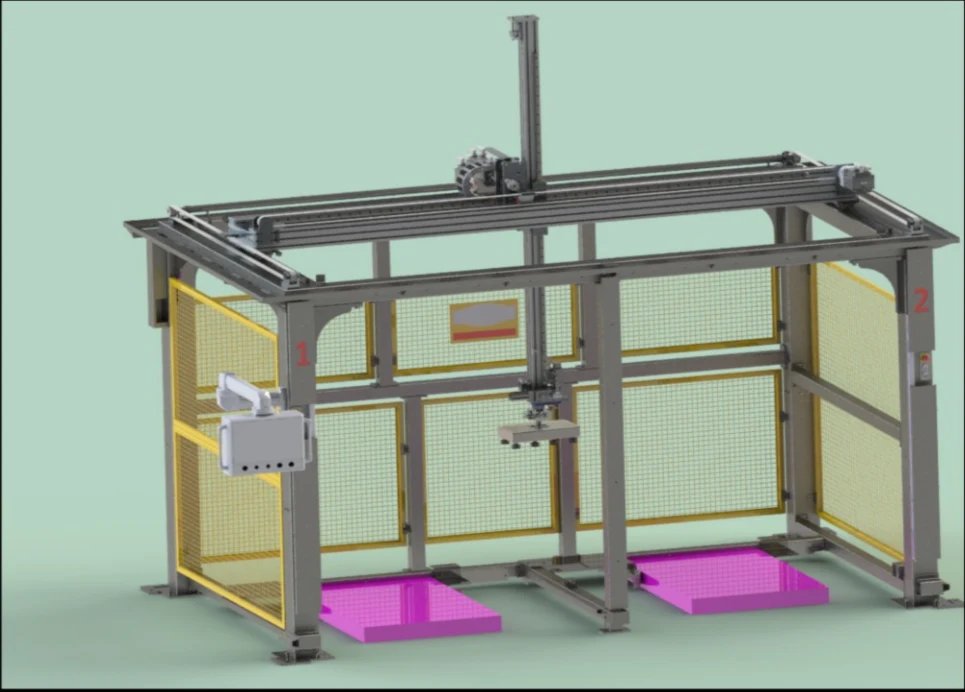
Main assemblies of the robot arm
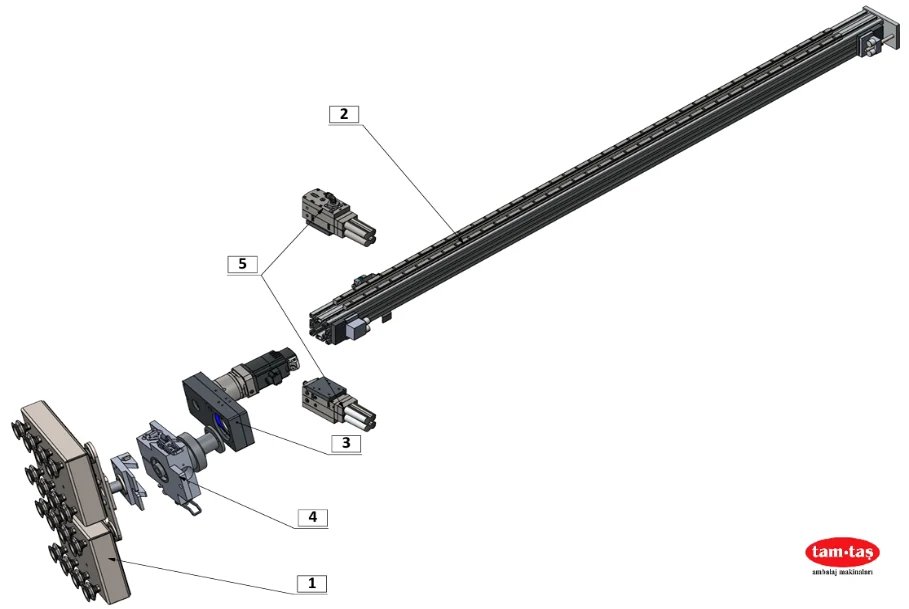
- Vacuum gripping unit: A multi-vacuum head that grips cases from above and can carry more than one case per cycle.
- Z-axis motion unit: Linear guides on aluminium sigma profiles position the robot arm up and down. The structure's rigidity is optimized for repeatable motion even at high speed.
- Gripper rotation unit: A timing belt and pulley system rotates the gripper through 360°, so cases are oriented precisely according to the pallet pattern.
- Connection unit: A modular interface that attaches the gripper to the robot body. Different gripper heads can be swapped quickly, shortening maintenance and changeovers.
- Vacuum generator unit: The generators that create the suction force sit on the moving structure itself, which keeps vacuum losses to a minimum.
Pallet layout optimization: the software offers four options
The pallet loading problem is an NP-hard packing problem. Exact methods guarantee the best result, but their computing time grows exponentially as the number of cases increases. Heuristic methods find patterns very close to the optimum within seconds, which is why they are preferred on fast production lines.
For a new product the operator only enters:
- Case width, length and height (mm)
- Pallet width and length (mm)
- Minimum gap between cases (mm)
- Maximum allowed stack height (mm)
With these inputs the algorithm treats the pallet as a two-dimensional rectangle and follows a few rules: placement starts from a pallet corner or from its center, cases are placed only horizontally or vertically, a case may overhang the pallet edge by at most 10 mm, and every position must be reachable by the robot arm without collision.
Within these limits the software balances three goals: maximizing the number of cases on the pallet, cutting energy use by shortening the robot's travel and rotations, and producing an asymmetric layer pattern. When an asymmetric pattern is mirrored on each layer, the layers interlock and form a solid load that does not shift in transit. With a symmetric pattern the mirrored layer would be identical to the one below, so this interlocking would not happen.
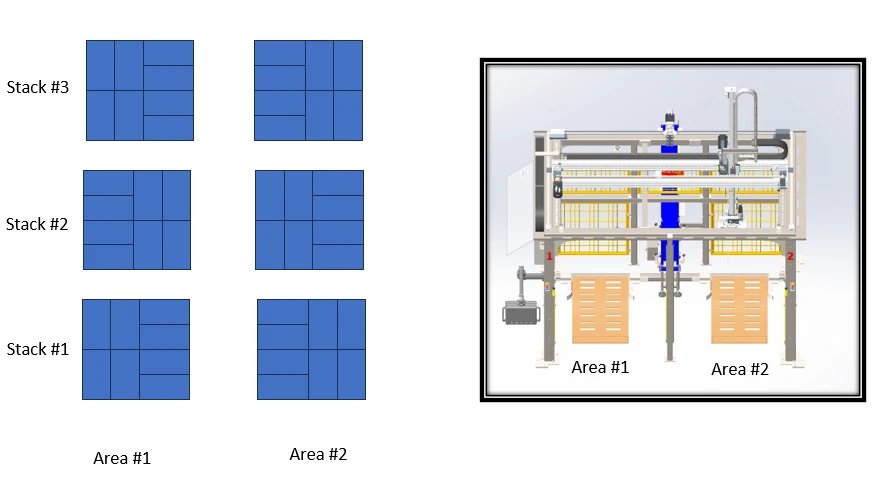
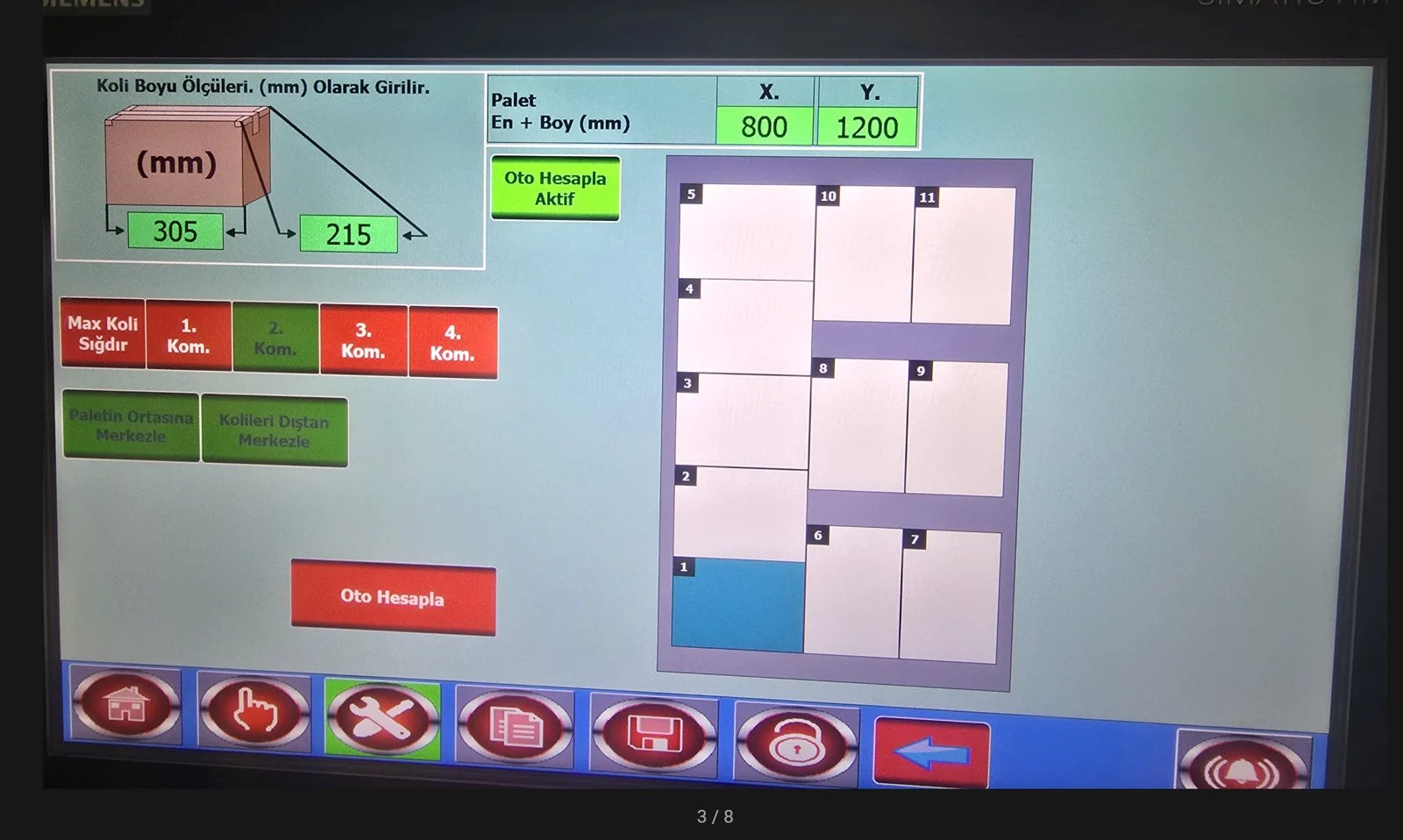
When the calculation is done, the software presents four layouts. Some reach the maximum case count, while others may offer a better-balanced asymmetric pattern with slightly fewer cases. The operator chooses according to priorities, can nudge individual cases on screen to fine-tune the pattern and can save it for recurring runs. As a result, a product changeover takes only five seconds.
Field results: 440 cases per hour, 400% energy efficiency
According to the field and test results, the machine stacks an average of 440 cases per hour and keeps pace with fast production lines. Intensive manual stacking that used to take an entire day is completed within minutes.
According to the test results in the paper, the 400% gain in energy efficiency has two sources: path optimization that shortens the robot's movements, and a gripper that carries several cases per cycle. The same pallet is therefore completed with fewer movements and less energy. While removing the end-of-line bottleneck, the machine also reduces the ergonomic and cost risks of manual stacking.
Background of the study
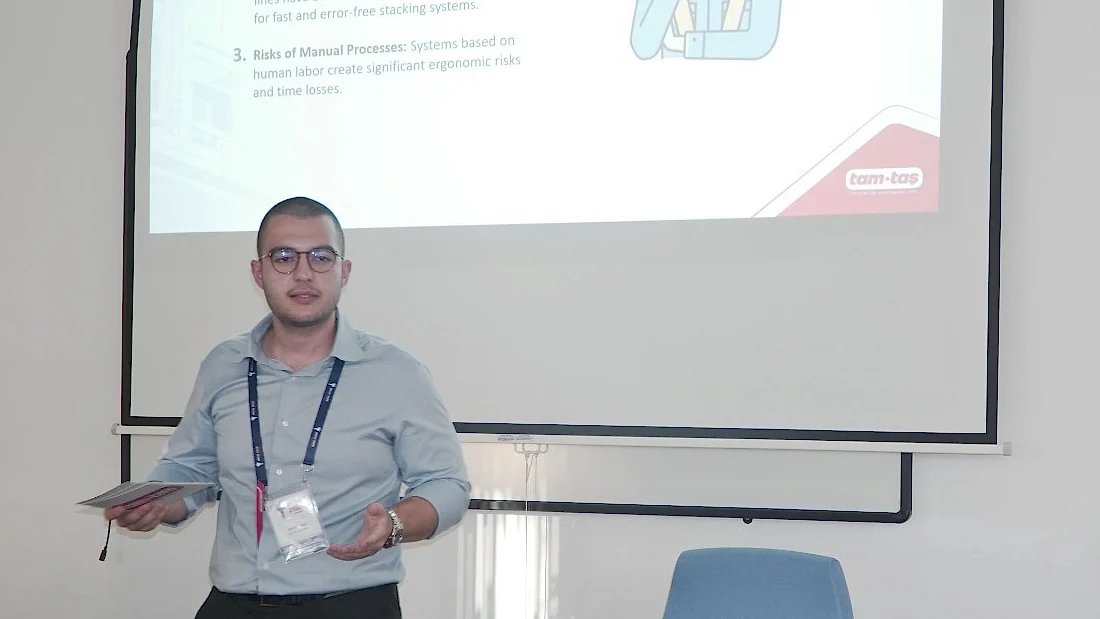
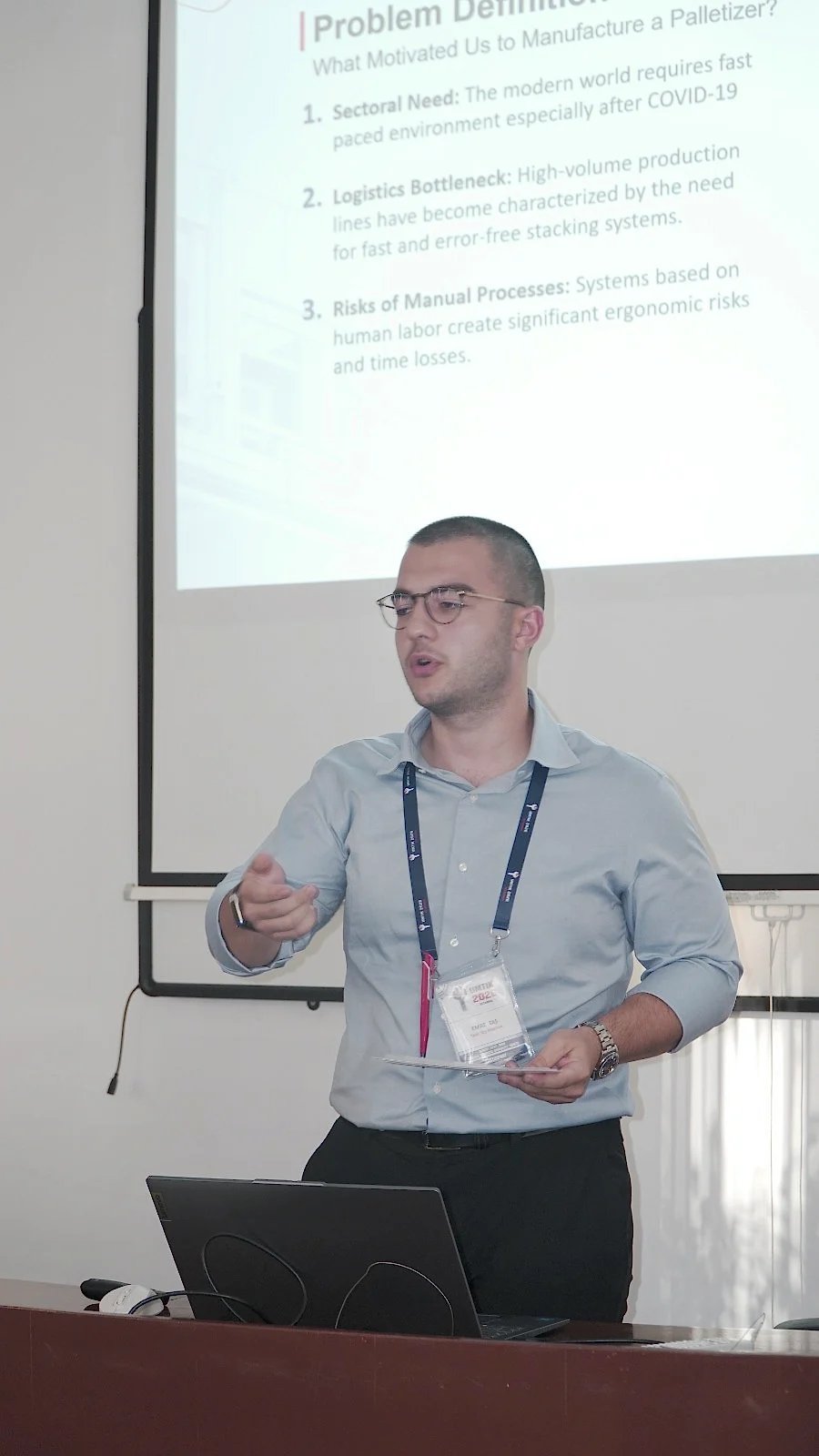
This article is based on the paper "High-Speed and Energy-Optimized Robotic Pallet Stacking Machine for Improved Logistics Efficiency in Production Lines", a joint study by Istanbul Technical University and TAMTAŞ. Its authors are Metin Candan (ITU), Gökhan Mengütay and Erdoğan Türkoğlu (TAMTAŞ) and Prof. Dr. Mustafa Bakkal (ITU). The study was presented at UMTİK 2026 by Emre Taş, Vice President of TAMTAŞ, who also reviewed this article.
Frequently asked questions
How many cases per hour can a robotic palletizing machine stack?
In field tests the TAMTAŞ robotic palletizer stacked an average of 440 cases per hour. Actual speed depends on case size, the pallet pattern and how many cases the gripper picks per cycle.
Which pallet and case sizes does it handle?
Pallet and case dimensions are entered in millimetres on the operator panel, and the software recalculates the layout for every combination. The sample calculation in the study used an 800 x 1200 mm pallet and 305 x 215 mm cases.
How long does a product changeover take?
Switching to a saved recipe takes about five seconds. For a new product the operator enters the case and pallet dimensions and picks one of the four patterns the software proposes.
Why use an asymmetric layer pattern?
When an asymmetric pattern is mirrored on each layer, the layers overlap and lock the load. This reduces the risk of the pallet toppling during forklift handling and shipment.
Can it be integrated into an existing packaging line?
Yes. The machine is designed to take cases from an infeed conveyor, so it can be added to the end of existing case packing and packaging lines. Each project is planned around the line layout, capacity target and pallet type.
A palletizing solution for your line
Robotic palletizing is the final link in TAMTAŞ line solutions from filling to palletizing; for the earlier stages of the line, browse the packaging machine catalog. You can see sample lines from filling to palletizing on the integrated lines page and reach our team through the quote form with your product and capacity target.